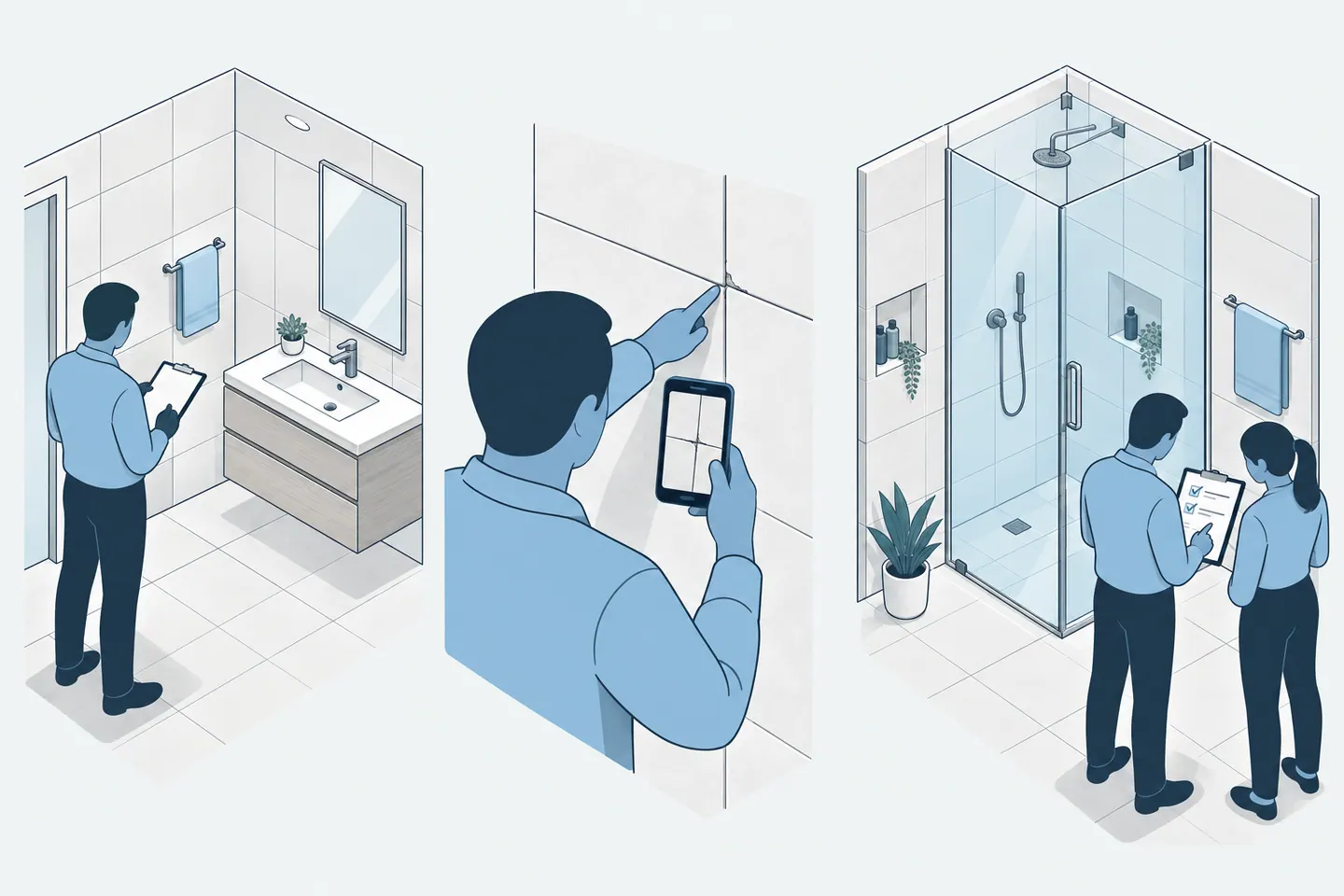
Bring the agreed scope and finish references
Check the room when it has been cleaned and is well lit. Bring the quotation, approved selections and any recorded variations. Photograph each snag with enough context to locate it, then add a close-up if needed.
Compare the installed product and layout with the approved information. Natural variation and product tolerances should be considered against the agreed sample and manufacturer guidance; do not assume every difference is a defect or every defect is cosmetic.
Check the visible finish
Ask the contractor to walk the room with you so questions are recorded consistently. Do not dismantle fittings or perform improvised flooding or electrical tests.
- Tiles and surfaces: record visible cracks, chips, staining or unfinished edges.
- Joints and junctions: check for visible gaps or incomplete finishing at corners and fittings.
- Vanity, mirror and accessories: compare the positions and selected finishes with the agreed scope.
- Doors and storage: ask the team to demonstrate normal opening, closing and access.
- Glass and screens: note visible damage and ask for the operating and care instructions.
- Cleaning and protection: identify residue, leftover materials or protection still to be removed.
Ask for a demonstration and the relevant records
Have the responsible contractor demonstrate the fittings, drainage and ventilation as appropriate to the agreed scope. If you see a leak, persistent ponding or another concern, record it and ask the team to investigate. Appearance alone does not establish that the concealed work is satisfactory.
Request the applicable inspection or test records for work that was covered up, together with product references, manuals and agreed warranty information. If a concern involves electrical systems, structure or concealed waterproofing, have the appropriate specialist assess it rather than relying on a photograph.
Write an observation the contractor can locate and answer
Use one reference per observation. “Bathroom finish is poor” gives the team little to investigate. “B-03: chip visible on the front-right edge of the vanity top” identifies a location and a visible condition without guessing its cause. Take an overview showing the fixture and a closer image of the same area; keep the original files under that reference.
Separate what you observed from the action proposed by the contractor. A mark may need cleaning, a surface repair or a replacement, but a photo alone cannot decide which treatment is suitable. Ask the responsible installer to identify the product and proposed remedy before agreeing how the item will be reviewed.
Use the following as a working record for your walk-through. It is an organisational aid, not a technical acceptance standard or a substitute for the agreed specification.
| Field | What to record |
|---|---|
| Reference and location | Unique ID, bathroom name, fixture and exact part of the fixture. |
| Observation and reference | What is visible; the approved selection or scope item if relevant. Keep assumed causes separate. |
| Dated evidence | Overview and close-up file names linked to the same ID. |
| Response and next action | Contractor response, proposed investigation or correction, named contact and agreed review date. |
| Access and adjacent finishes | Visit arrangements, any area kept out of use and protection or making good to be addressed. |
| Review and status | Reported complete, awaiting review, closed or still open; reviewer, date and evidence. |
Resolve residue and finish questions before attempting a remedy
If you cannot tell whether a mark is residue or damage, record it before anyone tries to remove it. Ask the contractor to confirm the installed finish and the applicable care guidance, then review the result of the agreed treatment. Avoid scrubbing a new fitting simply to make the observation disappear.
As a product-specific example, hansgrohe’s cleaning FAQ warns against abrasive cleaning materials and certain cleaners for its faucets and showers. The same page gives different guidance for other product categories. This supports checking the instructions for the actual item; it is not a cleaning recipe for every tile, stone surface or fitting in your bathroom.
Example: keep a screen-door observation open until it is reviewed
Hypothetical example: during the contractor’s normal-use demonstration, the shower-screen door catches instead of closing freely. Record the screen location and what happened as B-04. Ask the installer to investigate and confirm any restrictions on use; do not adjust the glass or hardware yourself.
The installer later reports an adjustment complete. Mark B-04 “reported complete — awaiting review” and arrange the agreed demonstration. Record the outcome under the same reference, along with any adjacent finish affected by the visit. If the original concern remains, keep it open with a new next action rather than starting an unrelated list.
This is a tracking example, not an ABA PRIME project claim or a technical diagnosis. The responsible specialist determines the checks needed. Keep the meaning of a handover signature and any payment decision within your project agreement; an item marked closed in this worksheet does not by itself settle other obligations.
Close the snag list in writing
A useful snag record contains the room, location, observation, photo, responsible party and target date. Ask how repaired items will be checked and whether adjacent finishes need to be protected or made good.
Review the corrections against the original observation. Keep a final copy of the agreed list and handover records for later maintenance. You can see the actual finished bathroom photographs in our Beach Mansion gallery on the Finishing Works page.
Planning your renovation?
Share your location, available drawings and intended scope. We’ll help identify the information needed for a quotation.